Wave-Like Behavior of Antimatter Atoms Observed for the First Time
For decades, quantum mechanics has bewildered us with the idea that particles like electrons can behave as waves. Now, that wave-particle duality has been demonstrated in an entirely new realm: antimatter. In a groundbreaking experiment, physicists have observed wave-like interference in positronium—an exotic atom made of an electron and its antimatter counterpart, a positron. This achievement not only reaffirms the strange predictions of quantum theory but also paves the way for novel experiments that could, for the first time, directly measure how gravity influences antimatter. Below, we explore the key questions surrounding this remarkable discovery.
What exactly is positronium and why is it special?
Positronium is an exotic, short-lived system composed of an electron and a positron (the electron's antimatter twin). Unlike ordinary atoms, which have a nucleus of protons and neutrons, positronium is essentially a two-particle bound state with no nucleus—just a particle and its antiparticle orbiting each other. Because both particles have the same mass but opposite charges, positronium is extremely light and unstable, typically annihilating into gamma rays within a fraction of a second. Yet, its simplicity makes it an ideal laboratory for testing quantum mechanics and antimatter physics. Observing wave behavior in positronium is especially challenging because the atom decays so quickly, but the recent success marks a major milestone in experimental physics.
How did scientists observe wave-like interference in positronium?
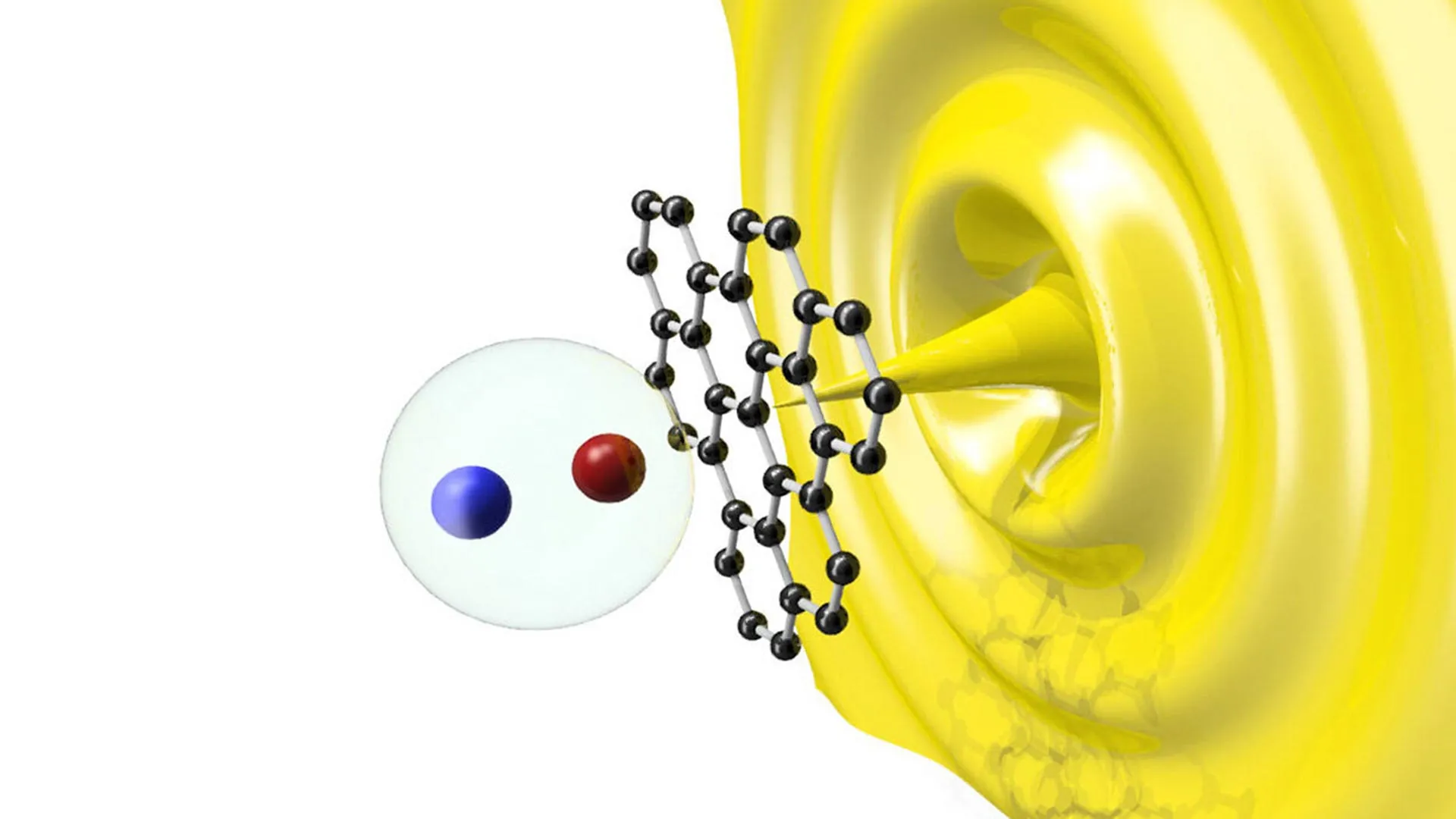
The research team used a technique similar to the classic double-slit experiment. They created a beam of positronium atoms and passed them through a nanofabricated diffraction grating—essentially a tiny mask with alternating open and closed slits. As the positronium traveled through the slits, its quantum wavefunction spread out and interfered with itself, producing a characteristic pattern of peaks and troughs in the number of atoms detected on a screen behind the grating. This interference pattern is the unmistakable signature of wave behavior. By carefully measuring the distribution, the scientists confirmed that the entire positronium atom, not just its constituent particles, behaves as a wave. The experiment required extremely sensitive detectors and precise control over the positronium beam, as the atoms annihilate within nanoseconds.
Why is this observation considered a breakthrough in quantum physics?
While wave-particle duality has been confirmed for particles like electrons, neutrons, and even entire molecules, this is the first time it has been observed for a system containing antimatter. Antimatter is notoriously difficult to trap and study because it annihilates on contact with normal matter. Demonstrating that positronium—an antimatter atom—exhibits quantum interference expands the scope of quantum mechanics to include antimatter systems. It also provides a new tool for probing the fundamental symmetries between matter and antimatter. Any deviation from the expected wave behavior could signal new physics beyond the Standard Model. Moreover, the ability to observe interference with antimatter opens up the possibility of using positronium in quantum optics experiments, such as matter-wave interferometry, which can test subtle effects like gravitational redshift on antimatter.
How does this experiment relate to the matter-antimatter asymmetry in the universe?
One of the biggest mysteries in cosmology is why our universe is dominated by matter, with very little antimatter. According to the Big Bang theory, equal amounts of matter and antimatter should have been created, but they would have annihilated, leaving nothing behind. The fact that we exist shows some asymmetry must have occurred. Studying antimatter properties in detail helps physicists look for subtle differences between matter and antimatter that could explain this imbalance. The wave-like behavior of positronium provides a new, highly sensitive test: if the interference pattern for antimatter differs from that of ordinary matter (e.g., hydrogen atoms), it could reveal a violation of fundamental symmetries such as CP (charge-parity) invariance. While the current experiment confirmed normal quantum behavior, future precision measurements could uncover tiny discrepancies that hint at why antimatter lost out.
Can this technique help test how gravity affects antimatter?
Yes, this is one of the most exciting prospects. Gravity's effect on antimatter has never been directly measured—we assume it's the same as on matter because of general relativity, but it has never been tested. Antimatter is so scarce and difficult to work with that traditional free-fall experiments are extremely challenging. However, with matter-wave interferometry, scientists can put an atom into a superposition of two different heights, then recombine it to see if gravity imprints a phase shift. If antimatter fell differently, the interference pattern would change. The recent observation of wave behavior in positronium means it can now be used in such interferometers. Because positronium is light and decays quickly, building a practical gravity interferometer will require further advances, but the path is now clear. Such an experiment could revolutionize our understanding of gravity or confirm Einstein's theory on a new frontier.
What are the next steps for research on antimatter wave behavior?
With wave interference demonstrated, researchers will focus on improving the coherence and brightness of positronium beams. One goal is to create a Bose-Einstein condensate of positronium, which would amplify quantum effects and enable even more precise tests. Another direction is to perform the experiment with different quantum states of positronium (e.g., ortho-positronium vs. para-positronium) to study how spin affects interference. Also, by comparing positronium interference with that of ordinary hydrogen (which has a proton instead of a positron), scientists can directly test whether matter and antimatter obey the same quantum rules. Ultimately, the long-term vision is to build a matter-wave interferometer that can measure the gravitational acceleration of positronium, providing the first direct measurement of gravity's effect on antimatter. Each step will require clever engineering and patience, but the door has been opened.